
Catalina of Motril
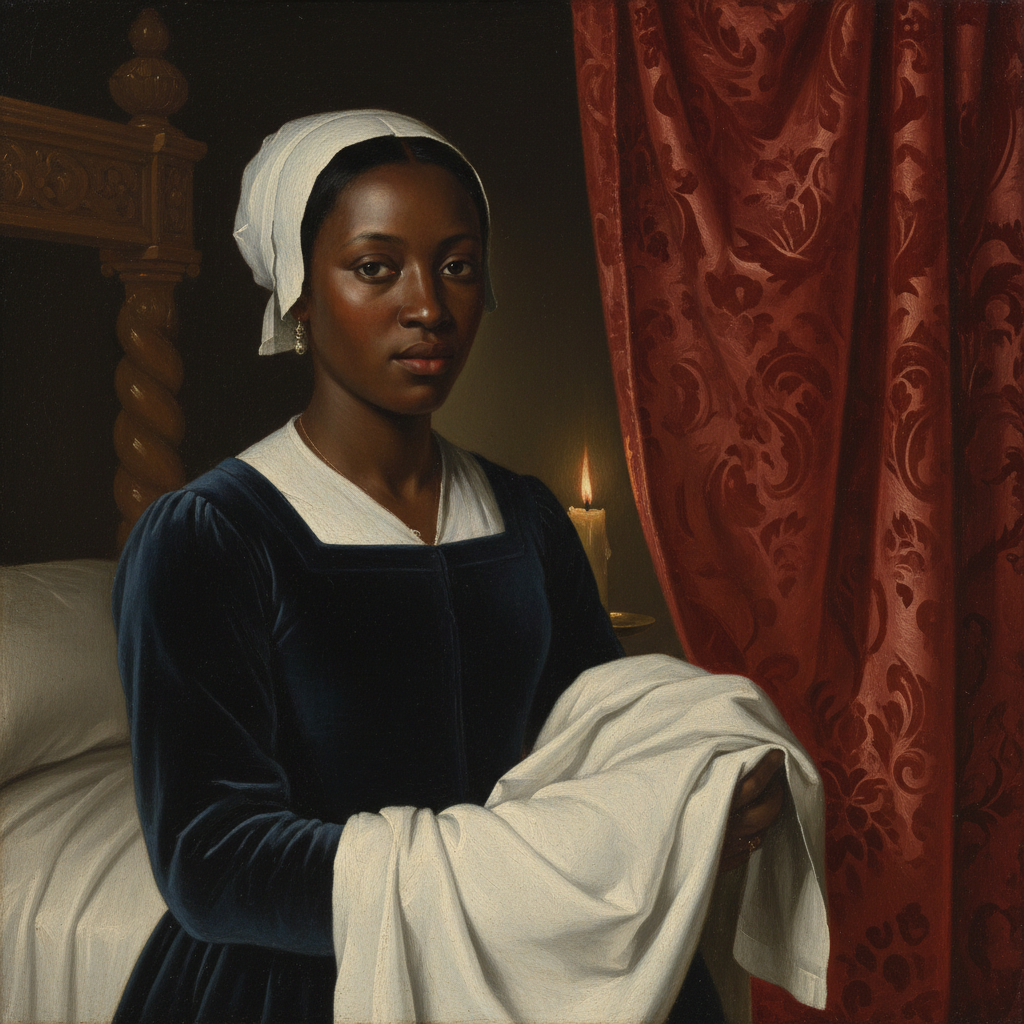
Catalina of Motril was a Black Moor brought to England in 1501 as Catherine of Aragon's bedmaker. Her testimony could have stopped Anne Boleyn becoming queen, and changed the course of English history forever.
5/18/202610 min read
The Bedmaker and the Queen
On the morning of 19 May 1536, Anne Boleyn knelt on a scaffold inside the Tower of London. She had been Queen of England for less than three years. Her death is one of the most famous in English history. But the woman whose story almost prevented it has been quietly written out of the picture for five hundred years.
Her name, as far as anyone wrote it down, was Catalina of Motril.
She was a Moorish woman from the Emirate of Granada, enslaved by Christian Spain and brought to England in the autumn of 1501 in the entourage of a fifteen-year-old Catherine of Aragon. She was a royal bedmaker. And by the late 1520s, as Henry VIII tore his kingdom apart trying to be rid of Catherine and marry Anne, Catalina became one of the quietly most important witnesses in Europe, because she alone had made the bed on a wedding night that would decide the future of the English throne.
Granada, before Catalina was called Catalina
Catalina was almost certainly not her birth name. The records that survive, a few scattered references in royal accounts and diplomatic letters, call her Catalina because that was the Spanish form of Catherine, the name of her mistress. Enslaved Muslim women in Christian Spain were routinely baptised and renamed after the household they served.
She was born sometime in the late 1480s in Motril, a port town on the southern coast of the Emirate of Granada. Granada was the last Muslim kingdom in Iberia, and Motril was a small, prosperous place of sugar mills and silk weavers. Then, in January 1492, the Catholic monarchs Ferdinand and Isabella entered the city of Granada and ended nearly eight hundred years of Muslim rule in Spain. The capitulation terms initially promised religious freedom. Within a decade those promises were broken. Those who could leave fled to North Africa. Those who could not were forced to convert, or were enslaved.
Catalina was among those enslaved. We do not know how she was taken, only that by 1501 she was attached to the household of the Spanish princess Catherine, daughter of Ferdinand and Isabella, who was about to sail north to marry a fifteen-year-old English prince called Arthur Tudor.
Was Catalina Black?
The Tudor and Spanish documents do not describe her appearance. They call her a slave from Motril, in Granada. They do not use the word Black and they do not use the word Moor in the records that survive about her directly. So how do we know?
The answer is the geography and the demography. Granada in the 1480s was Moorish, a population descended from the Berber and Arab armies who conquered Iberia in 711 CE, with substantial sub-Saharan African ancestry from centuries of trans-Saharan trade and slavery. Modern genetic studies confirm sub-Saharan ancestry across the Andalusi population. The Black African presence in Iberia was not a later addition. It was part of the founding.
When Tudor English documents speak of Moors and blackamoors they use the words to describe North African and sub-Saharan people of varied complexion. The mainstream of Black British heritage scholarship, Miranda Kaufmann, David Olusoga, Peter Fryer, Onyeka Nubia, Historic Royal Palaces, the Old Royal Naval College at Greenwich, places Catalina firmly in the Black Tudor cohort. To insist on a higher evidence standard for her Blackness than is applied to anyone else of her time and place is, as the historian Imtiaz Habib has argued, part of a long pattern in which Black presence in European history has to be proven again for every individual while white presence is assumed.
Catalina was a Black Moor. Her story is part of Black British history.
A note on her name, and the woman she has been confused with
Catalina of Motril is sometimes referred to in books, blogs and television dramas as Catalina de Cardonnes or Catalina de Cardenas. The surname is wrong. The contemporary Spanish records do not give her a surname. The conflation traces back to an 1874 publication by Mariano Roca de Togores, the Marques de Molins, which incorrectly indexed Cardones as the slave-girl in Catherine of Aragon's chamber. The mistake has been copied forward for over a century.
The real Dona Catalina de Cardenas was a separate person, a high-born Spanish noblewoman from the Cardenas family, who served Catherine of Aragon as a lady-in-waiting. White, free, aristocratic, and not the bedmaker. Two different women, conflated for a hundred and fifty years by a single indexing error. The fictional Catalina de Cardonnes in the Starz drama The Spanish Princess is a composite that inherits the error.
In this article she is called only by the name the documents give her, Catalina of Motril.
The wedding night that mattered
Catherine of Aragon's fleet landed at Plymouth on 2 October 1501. She married Arthur, Prince of Wales, in old St Paul's Cathedral on 14 November. Within weeks the newlyweds had travelled to Ludlow Castle on the Welsh Marches to begin their married life. Catalina went with them.
Her job was the queen's bedchamber. In the language of the records, she was an enslaved woman who used to make her bed and attend to other services of the chamber. That is a polite way of saying she handled the linen, including the linen of the marriage bed.
On 2 April 1502, less than five months after the wedding, Arthur died at Ludlow of a sudden illness, probably the sweating sickness. Catherine, also ill, survived. Henry VII, refusing to lose his Spanish alliance, betrothed her to Arthur's younger brother, the future Henry VIII. The two married in 1509.
For more than twenty years, the question of what had happened in Ludlow seemed settled. Catherine swore she had never been Arthur's wife in the full sense. The Pope accepted her oath, granted the dispensation, and the second marriage went ahead.
Catalina remained in royal service. She was still there in 1509, when the Spanish ambassador noted she had been present after Catherine and the new King Henry first lay together as husband and wife. She had handled the linen of two royal wedding nights.
Henry's Great Matter
By 1527 Henry VIII had decided to be rid of Catherine. She had given him a daughter, Mary, but no son. He had fallen for Anne Boleyn, a sharp-witted woman of his own court who refused to be his mistress. The whole religious and political map of Europe would be redrawn over the answer to a single question. Had Catherine of Aragon really been a virgin when she married Henry?
If yes, the marriage was valid and Henry was stuck. If no, Catherine had lied under oath to the Pope, the dispensation was meaningless, and Henry was free.
Catherine was questioned in humiliating detail and held her line. Arthur's old companions were dragged in to repeat boasts the dead prince had supposedly made the morning after the wedding. The evidence was inconclusive. The Spanish, defending Catherine, looked for witnesses of their own, and they thought of the woman who had handled the sheets.
By this point, Catalina had left England. Sometime between roughly 1509 and the late 1520s she had been freed. English law had no formal category for slavery, and the most likely reading is that her status simply lapsed once she remained on English soil. She had returned to Spain, married a Morisco crossbow maker called Oviedo, and was living quietly, by some accounts in Malaga, by others in Ezcaray in the north, with two daughters.
The order from the Spanish side in 1531 was blunt. Catalina, once Catherine's enslaved bedmaker, was to be sought out and, in the words of the record, thoroughly examined so she may say all she knows.
Her testimony, if it had ever reached the court, might have ended the case. Anne Boleyn might never have been crowned. The English Reformation might never have happened in the form we know it.
The silence
And here the trail goes cold. There is no surviving record that Catalina ever testified. No deposition, no signed statement, no letter from her hand. Whether the Spanish agents found her, whether she refused, whether she spoke and her words were buried, whether she was simply too far away and the case moved faster than the messengers, none of it is known.
What we do know is that the court ruled against Catherine. Thomas Cranmer, the new Archbishop of Canterbury, declared the first marriage to Arthur valid, which made the marriage to Henry invalid, on 23 May 1533. Eight days later, Anne Boleyn rode in coronation procession from the Tower of London to Westminster. Three years after that, Anne walked the other way and did not return.
Catalina disappears from the records around 1531. She is last described as a widow back in her birth town of Motril, in Granada.
Where Catalina appears in the documents
Catalina is named in very few places, which is part of why her story has been so easily lost. The key references are:
Spanish ambassadorial correspondence, 1509. A note that she was present in the bedchamber after Catherine and Henry VIII first consummated their marriage.
The records of Henry VIII's divorce proceedings, 1531. Describing her as once the Queen's slave, who used to make her bed and attend to other services of the chamber, and noting she had married Oviedo and was living in Spain with two daughters.
The dispatches of Eustace Chapuys, the Imperial ambassador in London, who tracked the search for witnesses on Catherine's behalf and referenced Catalina's absence from formal depositions.
She is never given a surname in any contemporary document. Any version of her name attached to a Spanish noble house, de Cardonnes or de Cardenas, is the result of a later editorial mix-up, not the historical record.
What historians agree on, and where they part company
Catalina has become a small but important touchstone in the rewriting of Tudor history, the work of putting Black and Muslim and Iberian lives back into a court they have always been part of.
Most historians agree on the basic shape of her life. Miranda Kaufmann, in Black Tudors: The Untold Story (2017), places Catalina alongside John Blanke and others as evidence that Tudor England already contained a small but real Black population whose status was very different from the chattel slavery of later centuries. David Olusoga's Black and British and Peter Fryer's earlier Staying Power treat her in the same spirit. Lauren Johnson, in So Great a Prince, has argued that Catalina holds the key to the biggest unknown in British history.
Historians part company on three points.
One. The two-Catalinas problem. The longstanding conflation of the enslaved bedmaker with the noble lady-in-waiting Dona Catalina de Cardenas has muddied the literature. Some older sources still refer to one woman where there were two. Careful scholars distinguish them, and Hidden Tudors Tours follows that practice.
Two. Did she know? On her access to the truth of Catherine's wedding night, historians are mostly in agreement. As royal bedmaker she would have handled the linen, and a stained or unstained sheet was the standard early modern proof of virginity. Where they differ is on how much weight to give her potential testimony. Sceptics point out that one woman's word, especially the word of a formerly enslaved woman, would not have outweighed the political momentum already behind Henry's case. Others argue that in a religious court the moral weight of a witness who had served Catherine for twenty-five years was considerable, and the Spanish would not have hunted for her so urgently if her voice carried no force.
Three. What happened to her after 1531? This is the deepest silence. The records simply stop. Some historians have read this as evidence that she returned quietly to family life in Motril and lived out her days unrecorded, as most women of her status did. Others have wondered whether she was actively silenced, Spanish, English, or both, because the answer she might have given was politically inconvenient on every side. There is no proof either way, only the absence.
Why Catalina matters now
Catalina's story is not a footnote to Anne Boleyn's. It is its own story, and it has its own meaning. A North African girl, taken in war as a child, carried to a foreign court, given a new name and a bedchamber to keep, who lived long enough to become one of the very few people who knew the truth that an empire was built on a lie about. She married, raised daughters, was widowed, and went home to a town her people had lost. The English Reformation rolled on past her without her name in it.
She is one of the reasons we walk the streets we walk. Tudor London was not a white city. It was a court of trumpeters and bedmakers and silk weavers and divers and ambassadors who arrived from Granada and Lisbon and the Guinea coast and stayed, and worked, and shaped the country they came to. Catalina of Motril is the Black woman whose silence, or whose unheard testimony, sits underneath the whole story of Henry VIII's wives.
Her name is worth saying out loud.
Frequently asked questions
Who was Catalina of Motril?
Catalina of Motril was a Moorish woman from the Emirate of Granada who was enslaved by Christian Spain and brought to England in 1501 in the household of Catherine of Aragon. She worked as a royal bedmaker, which meant she handled the linen of the queen's bedchamber, including the linen of the marriage bed.
Was Catalina of Motril Black?
Yes. Catalina of Motril came from Granada, a Moorish kingdom whose population descended from the Berber and Arab armies who conquered Iberia in 711 CE, with substantial sub-Saharan African ancestry built up over centuries of trans-Saharan trade. Mainstream Black British heritage scholarship, including Miranda Kaufmann, David Olusoga and Historic Royal Palaces, places her firmly in the Black Tudor cohort.
Was Catalina of Motril a real person?
Yes. Catalina of Motril was a real enslaved bedmaker in the household of Catherine of Aragon, named in Spanish court accounts of 1501, ambassadorial correspondence of 1509 and the records of Henry VIII's divorce proceedings in 1531. The character Lina in the Starz drama The Spanish Princess is a fictionalised composite based partly on her.
Is Catalina of Motril the same person as Catalina de Cardonnes?
No. Catalina of Motril was the enslaved bedmaker, while Dona Catalina de Cardenas was a separate high-born Spanish noblewoman who served Catherine of Aragon as a lady-in-waiting. The two women have been confused for over a hundred and fifty years because of a single indexing error in an 1874 publication by the Marques de Molins.
Could Catalina of Motril have stopped Henry VIII from marrying Anne Boleyn?
Possibly. Henry VIII's case for ending his first marriage rested on whether Catherine of Aragon had been a virgin when she married him, and Catalina of Motril, as the bedmaker who handled the linen of two royal wedding nights, was one of the very few people who could speak to the truth. The Spanish sought her out in 1531 so that she might say all she knew.
Did Catalina of Motril ever testify in Henry VIII's divorce?
There is no surviving record that Catalina of Motril ever testified. No deposition, no signed statement and no letter from her hand has been found, and it is not known whether the Spanish agents ever reached her.
What happened to Catalina of Motril after 1531?
After 1531 the records fall silent. Catalina of Motril had married a Morisco crossbow maker called Oviedo, had two daughters and is last described as a widow back in her birth town of Motril, in Granada.
Where is Catalina of Motril mentioned in historical records?
Catalina of Motril is named in Spanish court accounts of 1501, Spanish ambassadorial correspondence of 1509, the records of Henry VIII's divorce proceedings in 1531 and the dispatches of the Imperial ambassador Eustace Chapuys. None of these documents give her a surname.
Where can I learn more about Catalina of Motril?
Catalina of Motril's London is part of the Tudor city walked by Hidden Tudors Tours, where her story sits alongside John Blanke the trumpeter and the wider Black and Moorish presence in Henry VIII's court. Details are at hiddentudorstours.co.uk
Explore
Discover the hidden stories of Britain's Tudors.
Connect
Subscribe to Newsletter
contact@hiddentudorstours.co.uk
+44 (0)203 603 7729
© 2025. All rights reserved.