
Tudor Christmas Myths
Father Christmas, decorated trees, presents on Christmas Day – we assume these traditions are ancient, but most are Victorian inventions. Discover what Tudor Christmas was really like and the myths we still believe today.
TUDOR
12/22/20255 min read
Myth Busting
Although the quintessential British Christmas – such as Father Christmas, the decorated tree and the exchange of gifts on Christmas Day – appears to be steeped in ancient traditions, it is largely a Victorian invention. Thus, the Tudor Christmas, though equally joyous, was noticeably different, with only a few elements linked to the modern Christmas. Drawing on scholarly sources (Hutton, 1996; Heal, 2014; Weir and Clarke, 2018), this article will examine some common Tudor Christmas myths, demonstrating the distinct characteristics of the sixteenth-century festivities.
Christmas Trees
What is Christmas without the Christmas tree? The baubles and tinsel, the presents under the tree and the angel or Star of Bethlehem perched on top as a reminder of its religious purpose. The Christmas tree is a fairly recent tradition. It was first introduced to the British public in the nineteenth century. Although George III’s German wife, Queen Charlotte, is documented as having the first decorated tree, it would not become popular until 1848, when an engraving of Queen Victoria’s tree appeared in an edition of the Illustrated London News.
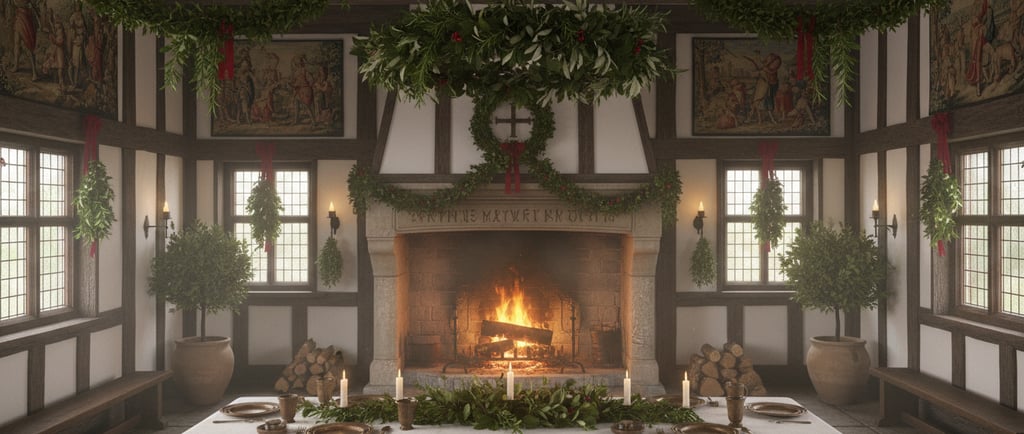
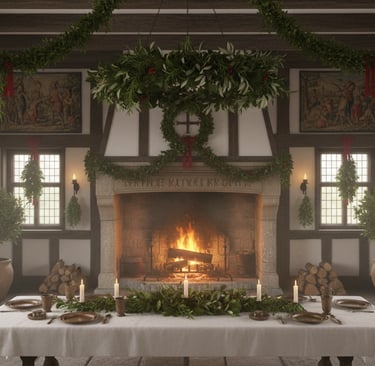
The Tudors did not have Christmas trees, but they did decorate their homes with evergreens during Christmas. Yule logs were also brought into the home and decorated. It is thought that this custom derived from winter or possibly pagan traditions, where evergreens were brought indoors to ward off evil spirits. This would later develop into a Christian ritual, with evergreens – such as ivy, rosemary, bay and laurel – used to decorate homes on Christmas Eve. The greenery also took on symbolic meanings (Hutton, 1996) with, for instance, holly representing Christ’s crown of thorns and evergreens signifying eternal life. Both churches and farming equipment were decorated, too, with the latter indicating that work ceased during the festive period. The kissing bough was a popular Tudor decoration. It consisted of a sphere made up of holly, pine and sprigs of mistletoe and was hung from the ceiling near the doorway. Guests were encouraged to embrace and kiss underneath it, which is where the kissing under the mistletoe custom evolved from. The evergreen decorations remained up for twelve days and were taken down on the morning of 6 January, the Feast of the Epiphany.
Presents on Christmas Day
Did you know that Tudor families did not give presents to each other at Christmas? Gift-giving did take place, but it was on New Year’s Day. The custom of exchanging gifts at the start of the new year derives from the Roman festivals, Saturnalia and the Kalends of January.
Saturnalia was a weeklong event to celebrate the Roman God of Agriculture, Saturn. It was a fun, yet chaotic festival with feasting, homes and roads decorated with evergreens and presents exchanged. Social rules were turned upside down, with masters serving their servants and enslaved people at banquets, and everyone allowed to wear colourful clothing regardless of status. A Lord of Misrule – a nominated servant – was given the job of overseeing the festivities. The Kalends of January was the start of the Roman New Year on 1 January. It consisted of festivities, processions and giving good luck gifts. Both Saturnalia and the Kalends of January would later evolve into Christian Christmas and New Year celebrations, leading to the custom of exchanging gifts on New Year’s Day.
Gift-giving was practised across Tudor society, albeit more modest exchanges among ordinary people. It was based on societal norms linked to a sense of duty or patronage rather than love or friendship. For instance, servants were rewarded with financial gifts, and the rich and powerful used it as an opportunity to demonstrate loyalty and gain political favour.
The exchange of gifts in Tudor courts was public – witnessed by courtiers - and recorded in gift rolls, with both gifts accepted and rejected by the monarch listed. Twenty-four gift rolls survive from the reign of Elizabeth I, and gifts include jewellery, exotic food, silks and luxury textiles (Heal, 2014). The rejection of gifts could seal one’s fate. In 1532, Henry VIII rejected Catherine of Aragon’s gift of a gold cup but accepted Anne Boleyn’s gift of boar spears. This signified that Henry no longer considered Catherine his wife. Similarly, Elizabeth I rejected a gift from the Duke of Norfolk. At the time, the Duke of Norfolk was imprisoned in the Tower of London for being involved in several plots against Elizabeth. While in prison, he sent a jewel to Elizabeth on New Year’s Day to demonstrate his loyalty. However, it was rejected, and he was later executed.
Non-stop Partying
The Tudors are well known for their fondness for merriment and feasting. There appears to be a common misconception that the Tudor Christmas was about non-stop partying, starting in early December. However, Christmas Day celebrations were actually preceded by four weeks of fasting, which began on Advent Sunday. Eating meat was forbidden during the four weeks, but eggs, fish and cheese were allowed. Hutton (1996) notes that the rich gave up meat and meat pies, but they ate soups, stews and fish. On Christmas Eve, the rules were stricter. Meat, eggs and cheese could not be consumed until after midnight mass. On Christmas Day, fasting stopped and lavish banquets were held by the wealthy. Tudor favourites included mince pies (made from meat) and turkey. Henry VIII was the first Tudor monarch to eat turkey after it was introduced to Europe from America.
It was also a period of spiritual reflection and atonement. In fact, preparations took place even earlier. On Martinmas, 11 November, animal slaughtering began and efforts were made to complete household chores before Christmas. In reality, no festivities took place until Christmas Day.
The Father Christmas Myth
Finally, let us debunk the Father Christmas myth. It is often believed that Father Christmas was an integral part of Tudor Christmas celebrations, perhaps due to the modern-day reference to Saint Nicholas. Although the Tudors celebrated St Nicholas Day on 6 December, this was not related to Christmas or Father Christmas. It was the custom to elect a choirboy to the role of “Boy Bishop”, which would involve acting as the bishop, including leading some religious ceremonies. He would perform this duty until 28 December and then go back to his role as a choirboy. This tradition was later removed by Henry VIII when he became Head of the Church of England, reinstated under Mary I and banned again under Elizabeth I.
In fact, the contemporary image of Father Christmas did not exist in Tudor Britain. However, there were personifications of Christmas in plays and household entertainment, such as Captain Christmas, Prince Christmas, The Christmas Lord and Lord Christmas, but their role was to preside over feasting and festivities - similar to that of the Lord of Misrule. These characters wore green, carried a club or staff, occasionally wore grotesque masks and did not distribute gifts. Father Christmas, rather “Old Father Christmas” did not appear until 1647, during the English Civil Wars, when the Puritan Parliament banned Christmas celebrations. As an act of resistance, the Royalists adopted the symbol of “Old Father Christmas” to preserve Christmas traditions. This figure was later adopted by the Victorians in the nineteenth century but combined with the Dutch St Nicholas traditions from the USA. Here, we see the emergence of the modern Father Christmas and his role as gift-bearer. He still wore green but was also dressed in brown or red. Father Christmas’s red clothing did not become dominant until it was popularised by Coca-Cola.
The Tudor Christmas was quite distinct from our modern Christmas Day celebrations, with no Christmas trees, Father Christmas or the exchange of gifts. However, despite its unique features, some elements laid the foundations for customs like kissing under the mistletoe and feasting on turkey and mince pies (made from meat).
Bibliography
Heal, Felicity, The Power of Gifts: Gift-Exchange in Early Modern England (Oxford: Oxford University Press, 2014)
Hutton, Ronald, The Stations of the Sun: A History of the Ritual Year in Britain (Oxford: Oxford University Press, 1996)
Lawson, Jane A. (ed.), The Elizabethan New Year's Gift Exchanges, 1559–1603, Records of Social and Economic History, New Series vol. 51 (Oxford: Oxford University Press for the British Academy, 2013)
Weir, Alison and Siobhan Clarke, A Tudor Christmas (London: Jonathan Cape, 2018)
Hidden Tudors Tours provides guided walks through London uncovering the stories of Black Tudors and Tudor Queens – the histories you won't find in the textbooks.
Discover more at www.hiddentudorstours.co.uk
Explore
Discover the hidden stories of Britain's Tudors.
Connect
Subscribe to Newsletter
contact@hiddentudorstours.co.uk
+44 (0)203 603 7729
© 2025. All rights reserved.